
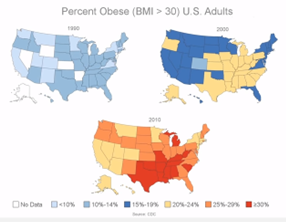
The new recommendations of the Dietary Guidelines Advisory Committee food pyramid of old has been replaced by a more scientific version, full of recommendations we and many other practitioners have been using for years to help our patients become healthier. This sea change is welcome to those of us who are alarmed by the charts below. One only needs to see the amount of orange and red below and the lack of light blue (<10%) that was present in 1985 to see the obesity epidemic in our country. It is not a failure of individuals but of systems and lack of a “metabolic reality” with regard to how processed foods effect our body. For example, prevalence of overweight and obesity is 73 percent among U.S. adults ages 20 years and older and 36 percent among children and adolescents ages 2 through 19 years, and prevalence of prediabetes is 38 percent among individuals ages 12 through 19 years.

We at the Center for Wellness Medicine offer the following commentary on the new dietary guidelines:
- Protein focused meals are back and we are so pleased, because they work! Building and maintaining muscle is the single most important factor to vibrant aging and performance in the young and independence for the “more mature.”
- The Committee views nutrition to promote health, not just to prevent disease. We have long held the view that it’s best to create health with lifestyle and diet, instead of waiting to treat disease.
- Don’t eat processed foods or drink sweetened/non-caloric sweetened drinks Period!
- The report promotes the importance of personalized nutrition programs to meet individual needs. Portions sizes, protein requirements, individual activity-based caloric needs and cooking methods name a few recommendations that we routinely offer. Although nobody becomes overweight eating protein and vegetables, specific guidelines can be very helpful at getting started.
- They underscore our concerns about chronic disease and the role that food plays in creating and perpetuating it.
- Low-fat food does not mean it’s good for you. Removing saturated fat and replacing it with processed foods was true misguidance and the foundation of our current health crisis.
- They call out the importance of a well-balanced gut microbiome and healthy digestion. We have been diligently working with this for decades.
This is a start to a food revolution, and we couldn’t be more thrilled.
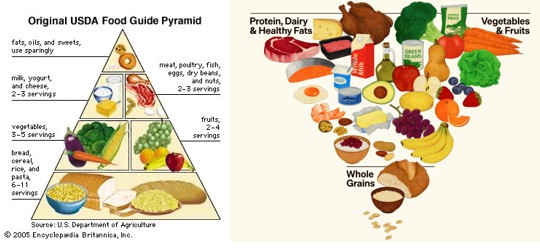
Here is a high-level review of the old vs. new pyramid.
- Priority of Foods
Old Pyramid
- Encouraged heavy carbohydrate foundation (grains) as diet base — minimal context for blood sugar effects or metabolic responses.
New Pyramid
- Prioritizes protein, healthy fats, vegetables, and fruits — aligning better with metabolic health, glycemic control, satiety signaling, and chronic-disease prevention.
- Encourages nutrient-dense whole foods over refined carbs.
- Protein Recommendations
Old Pyramid
- Protein foods grouped in middle tier; no specific per-body-weight guidance.
New Pyramid
- Increased protein recommendation tied to body weight (1.2–1.6 g/kg), emphasizing protein at every meal — supports muscle maintenance, immune function, and metabolic rate.
- Better reflects current evidence on protein for metabolic health.
- Fats & Dairy
Old Pyramid
- Fats and oils at the top, to be eaten sparingly — emphasis on low-fat dairy.
New Pyramid
- Healthy fats and full-fat dairy included as prioritized foods.
- Suggests fats from whole foods (olive oil, nuts, seeds, avocados) and even traditional fats (butter, beef tallow) though saturated fats are still recommended to stay within general calorie balance guidance.
Functional medicine note: The role of dietary fats is nuanced; whole-food fats are beneficial for cell membranes, hormones, and satiety, but overall energy balance matters. Saturated fats in excess may affect lipid profiles in some individuals.
- Refined & Processed Foods
Old Pyramid
- Did not explicitly address ultra- or highly processed foods.
New Pyramid
- Explicit call to avoid highly processed packaged foods and added sugars, citing them as contributors to chronic disease — better aligns with functional medicine emphasis on whole, anti-inflammatory foods.
- Added Sugars
Old Pyramid
- No specific added sugar limits.
New Pyramid
- Strong limits (≤10 g per meal; no amount is considered healthy), a major shift toward minimizing metabolic stress from sugars.
- Whole Grains & Carbohydrates
Old Pyramid
- Broad recommendation for grain servings with limited specification of whole vs. refined.
New Pyramid
- Focus on whole grains while sharply reducing refined carbohydrates — supports gut health, glycemic control, and reduced inflammation.
- Alcohol Guidance
Old Pyramid (Overall DGAs)
- Previously, guidelines suggested specific moderate alcohol limits.
New Pyramid
- Reduced alcohol consumption for optimal health outcomes with notes on who should completely avoid alcohol and those recommendations for those with a family history of alcoholism.
- This is extremely nuanced and should be discussed with your health care professional.
What These Changes Mean
Metabolic health focused: Higher protein and limited added sugars support insulin regulation and lean mass preservation.
Inflammation & chronic disease: Minimizing ultra-processed foods and refined carbs may reduce systemic inflammation and oxidative stress.
Nutrient density prioritized: Emphasis on whole foods (produce, protein, healthy fats) aligns with micronutrient and phytonutrient requirements.
Glycemic balance: Reduced refined carbohydrates and added sugars supports stable blood glucose.
Personalization still key: Even with population guidelines, individuals often require tailored macronutrient balance depending on health status.
In closing, we’re here to help!